

Richard McNeill
Richard McNeill
My Lived Experience with ME – Richard McNeill
Introduction Around 12,500 people in Northern Ireland are estimated to have ME, which represents 12,500 unique stories for how each of us became ill and have learnt to live with ME. This is not just our own lived experience, but that which our family and friends also experience of this disabling, chronic, complex, multi-system disease.
My name is Richard McNeill, I’m 52, single, live in Banbridge, and this is my own story.
In February 2023 I became critically ill with bacterial pneumonia and collapsed as quickly as my left lung did. Two days before collapsing, I ran a marathon and was thankfully as healthy and fit as I had ever been. My consultant quickly ruled out this race as the cause. A week after collapsing, I could just about walk 2 lengths of the hospital ward.
Back home after 3 weeks in hospital, I made good initial progress but by summer 2023 my recovery had stalled, and I was increasingly suffering from fatigue and pain. In May 2024 I had to stop work as a result, and a few months later, through diagnosis by exclusion, my GP concluded that I had ME. Having been unwell for so long, without explanation, this was a massive relief.
Her advice was to learn how to manage my own symptoms, which became my key objective in the last year, and to ask for her support when needed. To start with I had to work out what ME is and what having this disease means to me.
I also started to find out what any friends and family know about ME, and as quick as I was learning about the disease, I was starting to educate others. I often ask what they know about ME, or if they know anyone with ME, before I start to tell them what ME means to me. I was also keen to meet people who look and sound like me, which is how I found this charity. I quickly realised that fewer men have ME, but I also realised I already knew people with other chronic diseases that I can relate to. I am not alone, we have hope.
I heard soon after learning that I had ME, that only 5% of people recover. Those who do are predominantly in the first year of living with the disease and with the advice to do nothing. For me, my day zero with ME was when I collapsed with pneumonia, so I was already 18 months in when I heard this. At a time when I was pushing to recover from pneumonia, I have inevitably damaged my body further.
I quickly accepted that I won’t recover from ME, but instead my mindset change was to start thinking about what I can do to hopefully prevent my symptoms getting worse. My ME journey is very much about adapting as opposed to stopping. As a result, I have gratitude for what I can do as I continue learning to live my best life with ME.
On the scale of overall symptom severity between mild to very severe, my initial thoughts were that my symptoms were mild to moderate, but I now feel through lived experience that they are predominantly moderate. About 75% of people who have ME have mild or moderate overall symptom severity.
I have days where I feel on top of the world, but these are rare and then the reality of fatigue and exhaustion kicks in, but I still have a reasonable capacity for activities. Living with ME is a challenge and I feel I am on a never-ending learning curve. Every day is different and ME has changed my life. When I start to work out what can work for me successfully and sustainably, something happens that will change this. That said, I know my symptoms haven’t changed significantly in the last year and if they remain stable – albeit with the risk they may worsen – I can live with that.
Living with fatigue.
Fatigue is something I live with daily and is something I have grown to accept. I manage what I do around it and forever push my limits to find out what I am capable of. I know there will be good days and bad days, even good and bad within the day, and live with the inconsistency. I still do most household chores, but pace them over a few days instead of in few hours because it prevents excessive fatigue. I also get help from my Mum who lives nearby, and she has seen me at the highs and lows of ME.
Before I was first ill, I was an enthusiastic club runner and heavily into health and fitness. On one hand, that is the reason I was able to recover as much as I have, but on the other I know I will never run a marathon again. It has taken a lot of effort to get back to where I am now, and I am OK with that. Where before I could previously race a half marathon and train for a full, I can now run a 10K and carefully train for a half. This adaptation is OK and even though my pace has slowed, I am still able to run and that gives me so much pleasure.
I have also developed a change in my mindset whereby I appreciate that what I do can lead to “happy fatigue”, which is OK, whereas anything that causes “frustrating fatigue” will be changed. I have also adapted by getting involved marshalling at events, or with friends who want to learn to run (especially at the gym), both of which I find rewarding.
In addition to running, I still go to the gym, do Pilates and get out walking or hiking, but all of this is at a scaled back level compared to what I was doing before I was first ill. The people I train with have known me before I had pneumonia, so have seen me through the ups and downs of that and then with ME. In August 2025, I supported a major charity event that some of the gym members did and really pushed myself physically to help, knowing this would be a one-off event. Happy fatigue and a lot of resting afterwards, but this made memories.
I know that people would say not to exercise with ME, but for me it’s about balance about how much I do and how much I push myself. I know personally that my mental health, as well as my physical health, would suffer if I wasn’t able to exercise.
I recognised early on that fatigue isn’t just for physical activities, but it also comes from mental/cognitive, emotional and social activities. However, I find the impact from these activities is far less predictable and always plan around activities to try and avoid crashing.
Mental activities, especially working when I need to focus, is challenging and I need to rest frequently. I know my capacity is greatly reduced and I can only work on just one thing at a time. Doing anything takes a lot longer, and I find this frustrating. Socially I get energised by the people around me, especially those who understand and empathise with me and my ME, but I don’t necessarily have the capacity to hit the dating scene: this is not a priority for now.
Another source of fatigue that I am now very conscious of is heat. Hot weather at home is exhausting, and I am even more careful planning activities as a result. It is very different trying to live and run my home when it is hot, as opposed to relaxing on holiday.
Early on I heard about the “pace plan prioritise” principle and over time, I’ve learnt to apply this for any kind of activity and not just the more predictable physical ones. When I plan anything, I make sure there are rest days in the diary before and after to allow me to have the best chance to carry it out. I am getting better at listening to my body and stopping to rest when needed, to avoid Post-Exertional Malaise (PEM, also known as “crashing”).
Poor sleep and needing to rest through the day.
Fatigue and sleep are closely linked, and I really struggle with sleep. I can usually get to sleep OK but then I’m often awake during the night and regularly only get to sleep around 5am, even when I am tired. I have tried various OTC remedies and CBD oil, but they have limited effect and aren’t consistent.
When I do wake up, I never feel refreshed and am very slow to get going. I can set multiple alarms to help, but it usually takes an hour before I’m awake enough to get out of bed. We talk about the “faulty battery” analogy, and this lack of quality sleep really does impact my capacity for the day ahead.
I will always rest in the afternoon as I know from experience that my energy slumps around 2pm, so plan that into my diary. I also feel another slump coming around 8pm, by which stage I tend to be home anyway and exhausted from the day.
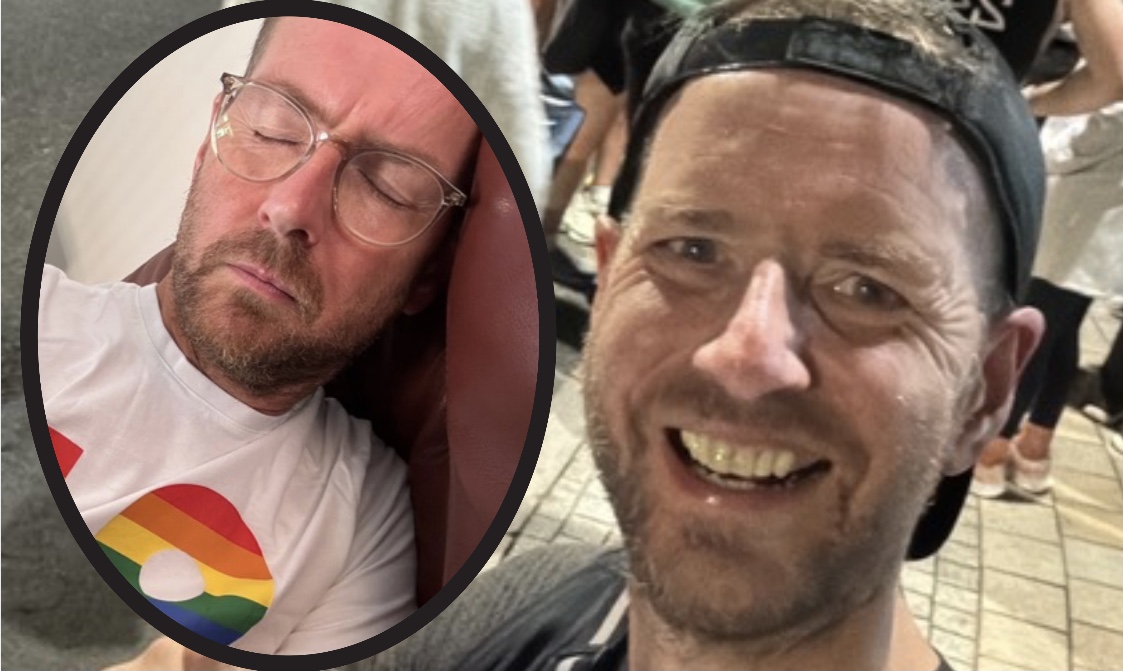
As I live alone, people don’t normally see me 5 minutes after I am get home. I get energised by the people I see and things I do, but then the fatigue and exhaustion hits when I get home and stop – as is evident in the photos that are accompanying this story.
I’ve recently talked to my GP about sleep issues, tiredness and exhaustion. This has been helpful as I’ve have started to accept that this is now my new normal and that between what sleep I get and additional rest during the day, my body manages to get sufficient rest overall.
Fatigue and the risk of crashing.
i have spent the last year working out what regular fatigue is as opposed to crashing (PEM), which I have had for weeks at a time, knowing that I’ve pushed too hard and repeatedly against my limits without sufficient rest.
My own interpretation of crashing is when my regular fatigue becomes unrelenting, accumulated, overwhelming and disproportionate. Sometimes it happens a few days after an event, but this is not consistent and I have also had it happen quite suddenly, but thankfully when I’ve had friends around. Hence, describing what crashing means to me and differentiating it to regular fatigue will forever be a learning experience.
I’ve learnt to live with the risk of crashing, but hopefully through decisions and adaptations, minimise the likelihood of it happening. I now watch for when the regular fatigue changes and then listen to my body, to try and avoid crashing as I know how it will adversely impact me and my symptoms. This isn’t always successful.
I am also aware that I didn’t crash after the charity event at the gym in August, during which I had made conscious decisions that really pushed me to my limits and that I knew would risk crashing. I have had heavy fatigue that has lingered for well over a week, but it has not felt unrelenting, accumulated, overwhelming or disproportionate, and I am grateful for that.
Concentration and brain fog.
My ability to concentrate has changed and become challenging. Previously I could have had music on but that is no more, and even the ticking clock had to be moved out of the study to get rid of background noise and distractions. I can only focus on one thing at a time. Even watching a TV programme needs my attention otherwise I will need to re-watch it to avoid missing details. This gets worse when I’m tired.
Brain fog is very frustrating. I am forever forgetting stuff, even down to the simplest thing like drinking the tea that is in the mug in front of me. I also write down a list of things to do, that can be ticked off so not to forget them. I use the calendar and set reminders on my phone, also using the notes app to capture ideas and reminders on the go. This is where being a programme manager has provided many helpful tactics to help live well with ME.
Other symptoms.
Tinnitus is a constant issue and gets worse when I’m tired and this really affects my ability to concentrate. I also suffer from muscle aches, pins and needles, poor temperature regulation, IBS, acid reflux, and other minor symptoms. These are all annoying in their own way, including later in the evening when I’m exhausted and struggle to get up the stairs to bed.
I have been using the Visible app for a year to monitor my symptoms and energy levels through daily pace points, which represent units of energy. By tracking my activities, especially running that utilises more pace points, I can anticipate the physical impact and recovery. I use the app data to analyse and predict these effects over time.
I also don’t beat myself up when things go wrong, I don’t have the energy reserve to be able to do that. Instead, I laugh things off as a coping mechanism, what else can I do?
Developing a daily routine.
I learnt early on that nothing happens fast with ME, that it has taken time to work out how it affects me, and how best I can live in a way that is both successful and sustainable. This was especially true when it came to finding a weekly routine. Through trial and error, I know that mornings are the best time for me to get things done, that I must rest in the afternoon which then allows me to train in the evenings. This is true for weekdays, which separates the “working week” from the weekend.
Finding this routine was also in anticipation of returning to work, although that hasn’t happened as there is no suitable role. I may get the opportunity to go back to work sometime in the future, even if this is part time.
Instead, I am planning to look for opportunities to volunteer, to have a sense of purpose and meaning. I am looking for something that ignites a passion in me, continues to make me curious, and probably gives back to society and my community. This feels like it is something that is more achievable as it would be part-time and better suited to me. Like everything, until I try, I won’t know what I can do and find where my limits are.
Challenges.
Living with ME isn’t all plain sailing. The last year has been a learning curve and there have been many ups and downs. I have had to deal with a lot of uncertainty about work, finances, my home and my disease, a lot of which has been very stressful and caused anxiety. Thankfully, I am now in a better place and have the right support around me.
I also have people who now know more about ME, and I happily talk to others about this invisible illness, especially when they comment about how well I look. This is particularly challenging, as I end up trying to explain to someone how ME affects me daily, whereas they see me infrequently and generally at my best. I need to point out that I have much less capacity now compared to before I was first ill and as already mentioned, living alone means almost nobody sees me 5 minutes after I get home, which is part of my own reality living with ME.
I have also learnt how to be more kind to myself, and journalling has helped me capture how I feel as well as how my symptoms are changing over time.
Final point.
A good friend of mine talks about reflected knowledge being wisdom, which is a great way for me to think about my ME journey so far. There is also a parallel to the Serenity Prayer which says “...to accept the things I cannot change, courage to change the things I can, and wisdom to know the difference."
My mindset is that living with ME is my new normal, and it is down to me, my wisdom and my choices as to how I can continue learning how to live my best life with ME going forward. This is with ME and not despite it, as my ME isn't going anywhere.
Stories like this can help others feel less isolated, be it with ME or another chronic condition. I also hope the pictures included, of how I usually look in running gear and how I look when at home exhausted, make sense. This helps make us more visible, and I hope what I have written in my story has resonated with someone reading it.
Thank you, take care and please be kind to yourself
Richard McNeill
September 2025

 On Facebook
 On X
On X On Instagram


