

Justine Sneddon
Justine Sneddon
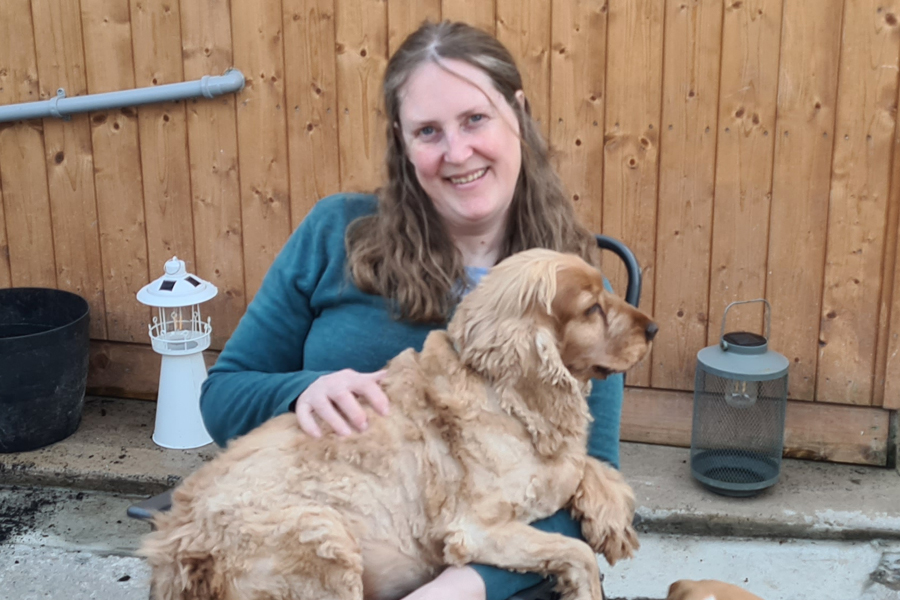
How M.E. Changed Justine Sneddon's Life
Life seemed to change overnight for Justine Sneddon.
A self-described perfectionist who was always on the go, her life came to a halt when she slowly noticed herself becoming more fatigued while recovering from an emergency back operation.
However, she pressed on, eager to continue to live her life as normal as possible - including her fulfilling all the duties in her role as a senior support worker.
“I carried on and pushed on because that’s the personality I have, just carried on to the point where in work on my break I would be sitting up in a chair and fall asleep in 30 seconds,” Justine said.
During her breaks, the 53-year-old from Keady in County Armagh would often set alarms to make sure she was awake to begin her shift again.
The gruelling cycle continued until around Christmas 2022 when her body hit a breaking point.
“I was in work and I felt really dizzy,” she said.
“I was so fatigued, I literally couldn’t walk, I couldn’t lift my head, everything was spinning, I couldn’t feel my legs.”
Soon after, the mother-of-three was rushed to A&E where she was later admitted to hospital. This was the first time she realised that it was something beyond surgery recovery and regular life stresses.
Despite being kept in over the festive period, many of the tests Justine underwent came back inconclusive. She was discharged, and told she would be sent to a neurologist as an outpatient to find the underlying problem.
With her neurologist off on leave and only one year of sick leave offered by her employer, Justine was left to search for answers in the depths of search engines alone.
“I was Googling everything,” Justine said.
“The waiting for everything was months and months. I was phoning up trying to just say I can’t live like this.
“Every time I went to the GP I’d be in floods of tears because I would be talking about it and then the GP would say, ‘Our hands are tied, you’re under the neurologist’.
“It was like, ‘Where’s my life gone?’ My life has just changed overnight and no one is even helping.”
In the lacuna of professional medical advice, all of Justine’s searches brought back just one result where the puzzle pieces fit: myalgic encephalomyelitis (M.E.).
Armed with that knowledge, she was determined to inform the neurologist of her discovery but just one day before her appointment, her fatigue caused her to fall in the kitchen and fracture her leg.
She was later discharged back into the care of her GP who confirmed her suspicions.
Now, five months after her official diagnosis, Justine is still adjusting to her new normal.
At her worst she will spend days in bed, only leaving to go to the bathroom. Conversations can also be a struggle with brain fog making her forget important conversations or appointments.
Before her diagnosis, Justine said: “I can fall asleep anywhere sitting up, I would park the car and be so fatigued I would just literally sit in the driver's seat and be asleep sitting up.”
Now, Justine understands how to PACE, an activity management strategy designed to help M.E. patients minimise the number and severity of relapses while staying as active as possible. This approach includes taking a rest after each activity.
Even something as simple as watching television or meeting a friend for coffee can be a struggle for Justine due to her condition.
She added: “For me there’s a definite my old life and my new life. I’m only just turning into ‘Oh that’s right I had an old life’, because now I'm trying to figure out what my new life is.
“For months and months and months, I was literally going, ‘What is the point of me?’
“I have no job anymore, I lost my job.
“I can’t meet people, I’m a people person, I’ve worked with people for 20, 25 years, helping people. What am I doing here?
“There’s a huge amount of guilt. I feel guilty all the time because [I think] maybe I am making this up. I know 90% of people think I’m making this up.
“The more I try to convince people, the more the M.E. becomes my identity and I don’t want the M.E. to become my identity.”
While she learns to live with the incurable condition, Justine has been busy re-discovering her life’s purpose and channelling that energy into a side project.
She started knitting therapy teddy bears that the Police Service of Northern Ireland and the Northern Ireland Fire and Rescue Service can give to children at the scenes of devastating incidents. Unfortunately she can no longer do that but now knits cuddly toys and give them to a local children's charity to give to the children they work with.
It’s helped her to refocus and cope with the mental struggles the condition can bring.
She said: “Unless you find your purpose, it’s going to be an even tougher struggle and maybe you don’t have energy or think you don’t have energy, it all links back to mental health.”
Justine said she was in “complete shock” that there were no specialised services for the condition in Northern Ireland, and urged politicians to make the issue a priority so people like her could have a glimmer of hope.
She explained: “I said to someone the other day it’s really sad that there are no services and someone said, ‘Well sure there’s no cure’.
“Services aren’t to do with cures. Services are to do with support, getting the best quality of life with what you have.
“To be told there are no services and to join a support group instead, it’s shocking.”
Justine has also been attending counselling to help her combat some of her feelings around her new life.
“I learnt so much about feeling guilty for not being normal, feeling guilty, having to excuse myself and that was just incredible.”
Despite being at what some may consider an early part of her M.E. journey, Justine is trying to find her way back to normal.
“I had to go through losing my identity, and everything I used to be able to do and what I can do now. It makes me so sad.
“Your whole life is trying to put out fires that your illness has made. I’m forgetful, I’m tripping, I’m breaking bones, while constantly trying to manage what the symptoms do to relationships.”
Despite the immense challenges Justine has faced, she remains determined to raise awareness about M.E. and advocate for better support and services. Her story highlights the urgent need for increased understanding and resources for those living with chronic illnesses.
If you or someone you know is suffering from or needs more information on Encephalomyelitis / Chronic Fatigue Syndrome (ME/CFS) Contact us

 On Facebook
 On X
On X On Instagram


