

Six Myths & Facts Everyone Should Know About M.E.
Six Myths & Facts Everyone Should Know About M.E.
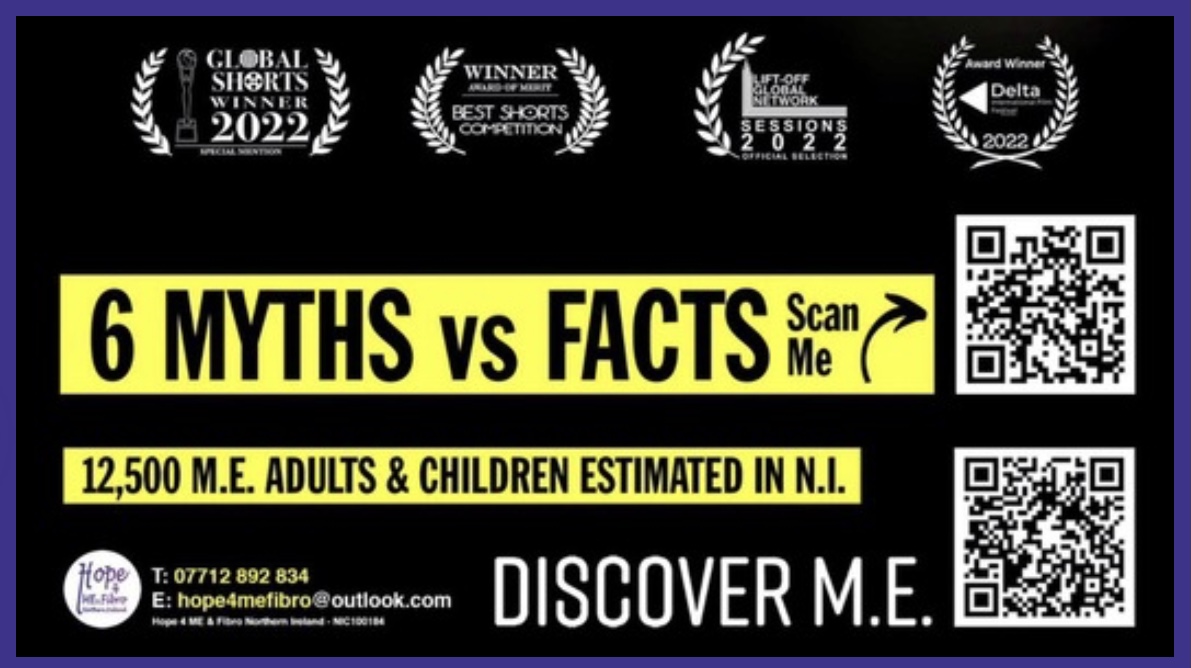
We’re excited to launch our brand-new A5 flyers, now being distributed across Northern Ireland! Each flyer includes two quick-scan QR codes to make learning about M.E. simple, fast and evidence-based for busy healthcare professionals. The codes lead to -
1/ Discover M.E. - A powerful 6-minute film offering a compelling overview of the lived experience of Myalgic Encephalomyelitis, through the voices of real Northern Ireland patients.
2/ World ME Alliance - Six Myths & Facts Everyone Should Know About MyalgicEncephalomyelitis (ME)
The following information is taken from World M.E. Alliance website.
6 Myths vs Facts – A must-read from World ME Alliance busting the most common misconceptions about M.E. with clear, science-backed facts.
Whether you're a GP, medical student, nurse, physio or policymaker, these resources are designed to fit into your schedule while transforming your understanding of this often-misunderstood condition.
Look out for our flyers in clinics, universities and at events – or contact us if you'd like a batch for your workplace
Myth 1:
When ME is misclassified as a mental illness, it distorts the entire ecosystem of healthcare, research, and social support—leading to misdiagnosis, harmful treatments, lack of services, and stalled scientific progress.
Share this to help correct one of the most harmful misconceptions about ME.
Myth: ME is a mental health condition.
Fact: ME is a biological illness that disrupts the metabolism and impairs the brain, immune system and autonomic nervous system.
It often starts after an infection, common flu or COVID. Millions of people worldwide have ME, with about 75% of them being women. Many struggle with daily activities, up to 75% cannot work or attend school, and at least 25% of patients are so severely affected that they are housebound or bedridden.
—————-
Myth 2:
If people truly understood that ME is not “just tiredness,” we’d stop telling patients to push through—and start protecting them from getting worse.
Share this and help others understand what ME is really about.
Myth: ME is just about feeling tired.
Fact: The defining symptom of ME is Post-Exertional Malaise (PEM) - an extreme worsening of symptoms after even minor physical or mental exertion. This can trigger a “crash” lasting for days or longer, making even basic activities difficult or impossible. Attempting to push through can significantly worsen symptoms and may lead to long-term deterioration. For those with severe ME, even minimal exertion—such as sitting up, light conversation, or sensory stimuli like sound and light—can be intolerable, leaving them extremely disabled and dependent on full-time care.
—————
Myth 3:
When doctors and loved ones believe exercise will help, people with ME end up pushing themselves into long-term harm. That belief has cost lives.
Share this to help protect people with ME from harmful advice.
Myth: You can exercise your way to recovery from ME.
Fact: Exercise can be dangerous for people with ME.
Unlike other chronic conditions where exercise can help, structured exercise programs often make ME symptoms worse as patients end up pushing themselves too far.
In the past, graded exercise therapy (GET) was recommended, but after reviewing the evidence, health organisations like NICE in the UK and the CDC in the US have warned against it. Instead, people with ME are encouraged to pace themselves—balancing activity and rest—to avoid deterioration.
——————
Myth 4:
Assuming ME only affects certain people leaves too many undiagnosed, unsupported, and suffering in silence—especially in marginalized communities.
Share this to help make ME visible for everyone it affects.
Myth: Only certain groups of people can develop ME.
Fact: ME affects people of all races, genders, ages, and socioeconomic backgrounds.
The misconception that ME primarily affects certain groups stems from disparities in diagnosis and healthcare access. While about 75% of those affected are women, ME can affect anyone, regardless of age, gender, race or income. In addition, marginalized communities face more challenges getting diagnosed and treated due to bias in the medical system and lack of awareness.
——————
Myth 5:
Recognizing the overlap between ME and Long COVID could accelerate research, improve care, and build bridges between patients who’ve been dismissed for decades and those newly affected.
Share this to support unified research and treatment efforts.
Myth: Long COVID is entirely different from ME.
Fact: Many Long COVID patients have symptoms that match ME.
Since the COVID-19 pandemic, researchers have found that a large number of people with persistent Long COVID meet the diagnostic criteria for ME. Many experience Post-Exertional Malaise (PEM) - an extreme worsening of symptoms after even minor physical or mental exertion which is the core symptom of ME. Studies highlight the biological similarities between the two diseases, reinforcing the need for integrated research and clinical approaches for these two conditions as well as other post-infectious syndromes.
——————
Myth 6:
Believing there’s “nothing doctors can do” leads to patient neglect - but there are ways to ease suffering and improve lives.
Share this to remind the world that ME patients deserve proper care.
Myth: Doctors cannot help people with ME.
Fact: Doctors can help people manage ME symptoms.
While there is no cure for ME, there are compassionate ways to help patients manage their symptoms, in addition to pacing to prevent PEM. Treating co-existing conditions and providing medications to address sleep disturbances, pain, and cardiac and neurological issues can offer significant relief. Offering at-home visits, online consultations and palliative care can make a big difference to someone suffering from Severe ME.
—————————————————————————————————
For more information on treatments, check out these trusted resources:
U.S. ME/CFS Clinician Coalition Guidelines: https://mecfscliniciancoalition.org/
UK NHS Guideline: https://www.nice.org.uk/guidance/ng206
Patient-Reported Treatment Outcomes in ME/CFS and Long COVID: Eckey, M., Li, P., Morrison, B., Davis, R. W., & Xiao, W. (2024). medRxiv, 2024-11. Link
Manual of Medicine. (n.d.). Essential drugs and therapies for ME/CFS, Long Covid, and Fibromyalgia symptoms relief. Retrieved March 5, 2025, from https://manualofmedicine.com/me-cfs-fm-long-covid/essential-drugs-therapies-me-cfs-long-covid-fibromyalgia-symptoms-relief/
Grach, S. L., Seltzer, J., Chon, T. Y., & Ganesh, R. (2023, October). Diagnosis and management of myalgic encephalomyelitis/chronic fatigue syndrome. In Mayo Clinic Proceedings (Vol. 98, No. 10, pp. 1544-1551). Elsevier. Link.
Key References:
Bateman, L., Bested, A. C., Bonilla, H. F., et al. (2021). Myalgic Encephalomyelitis/Chronic Fatigue Syndrome: Essentials of Diagnosis and Management. Mayo Clinic Proceedings,
Centers for Disease Control and Prevention. (2024). ME/CFS Basics. Retrieved from cdc.gov.
Clayton, E. W. (2015). Beyond Myalgic Encephalomyelitis/Chronic Fatigue Syndrome: An IOM Report
Davis, H. E., McCorkell, L., Vogel, J. M., & Topol, E. J. (2023). Long COVID: Major Findings, Mechanisms, and Recommendations. Nature Reviews Microbiology.
National Institute for Health and Care Excellence. (2021). Myalgic encephalomyelitis (or encephalopathy)/chronic fatigue syndrome: diagnosis and management (NICE Guideline NG206). Retrieved from nice.org.uk.

 On Facebook
 On X
On X On Instagram


