

NI DIRECT Updates Health Conditions A - Z on M.E.
NI DIRECT Updates Health Conditions A - Z on M.E.
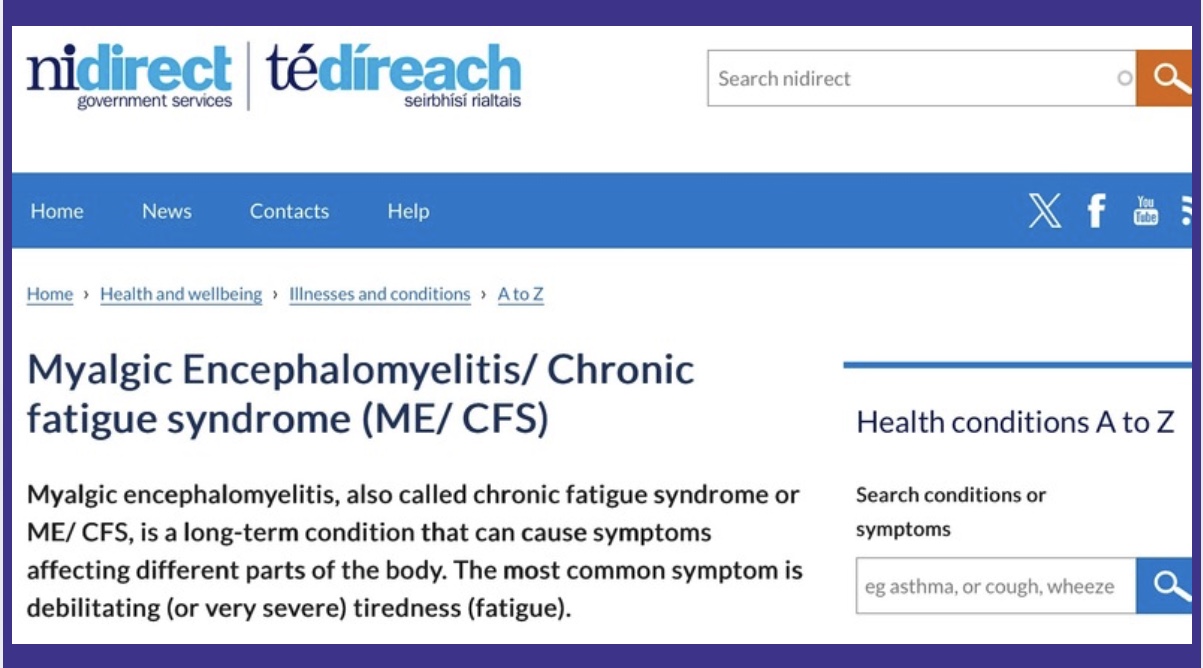
Due to Hope 4 ME & Fibro N.I., persistent efforts, NI DIRECT Health Conditions A-Z, has finally updated its ME/CFS health page in line with the *2021 revised NICE Guideline NG206
See HERE
Some contradictory statements remain to be addressed. As N.I. DIRECT is a public facing webpage, we have requested the following statement is removed in its entirety, due to our patient safety concerns as outlined below.
“While exercise can be helpful for some, it may worsen the symptoms of others”
- This line contradicts the correct information under ‘Symptoms’ on N.I. Direct and this statement is dangerous and misleading in the context of Myalgic Encephalomyelitis (ME/CFS) for several reasons:
- -Implies Exercise *Might Be Beneficial in M.E.
- This wording wrongly suggests that exercise could be a treatment for some M.E. patients. That contradicts current medical guidelines and fails to account for the core symptom of the illness: Post-Exertional Malaise (PEM)—a worsening of symptoms after even minimal physical, cognitive, or emotional effort.
- Downplays the Risk of Harm
- It presents symptom worsening as a possibility rather than a known, common outcome. Research shows that many people with M.E., especially moderate to severe cases, experience prolonged or irreversible deterioration after exertion. This framing risks encouraging activity levels that are unsafe.
Reinforces Misconceptions:
- · It fuels the false narrative that M.E. is like fatigue from deconditioning, and that some patients just need to “push through.” This misunderstanding has historically led to the use of graded exercise therapy (GET)—a now-discredited and harmful approach condemned by the 2021 NICE guideline (NG206).
-Ignores Clinical Guidelines
- The NICE NG206 guideline explicitly rejects graded exercise therapy and states that people with M.E. should not be advised to undertake exercise programs that do not consider PEM. It promotes pacing and energy management, not exercise, as the safest way to manage symptoms.
Risks Undermining Patient Credibility
- By implying some might benefit from exercise, it can lead healthcare providers, families, and employers to doubt the seriousness and complexity of M.E., pressuring patients into harmful activity levels and reducing support for accommodations.
In Summary:
The phrase appears moderate but masks real dangers. M.E. is not simply about fatigue—it’s about an abnormal biological response to exertion. Safe care must centre on recognising PEM, individual energy limits, and protecting patients from harm—not leaving the door open to therapies known to worsen the disease.
It is also incorrect for NI DIRECT to state M.E. causes irregular heartbeats.
27/05/2025:

 On Facebook
 On X
On X On Instagram


