

Ability Magazine M.E. Feature
Ability Magazine M.E. Feature
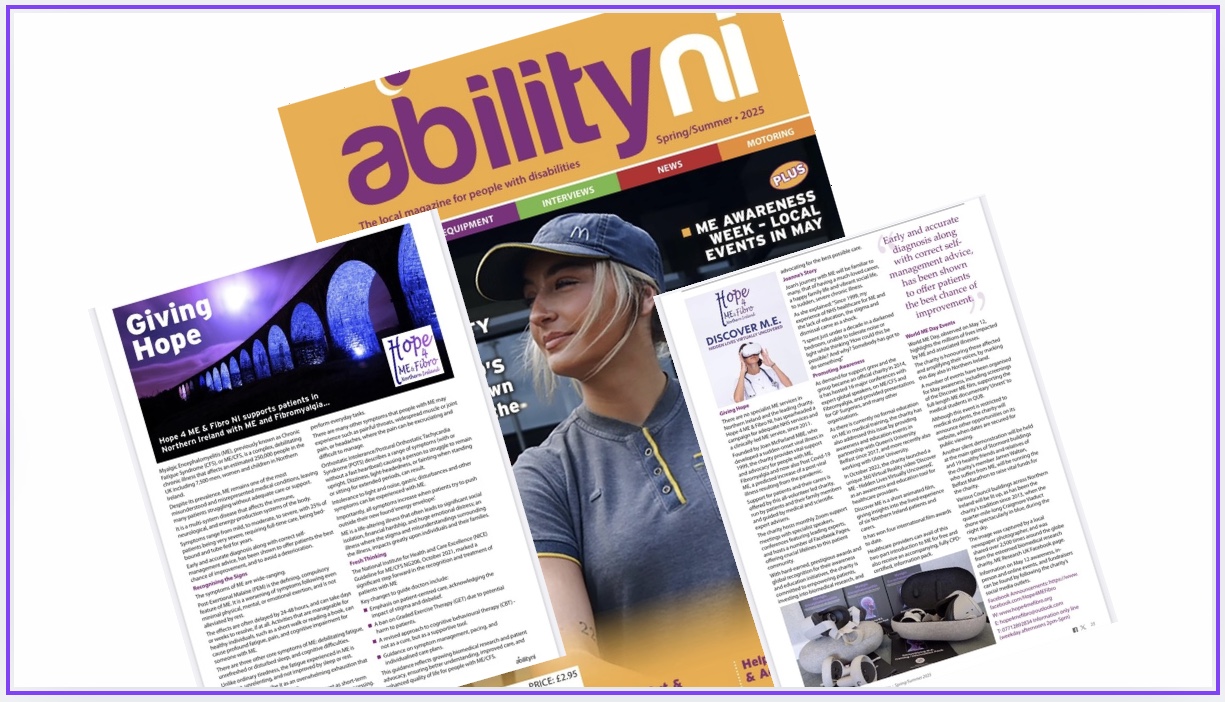
Thank you to Ability NI magazine for raising awareness for M.E. with a 2-page feature in the run up to World M.E. Day 2025!
Read the feature here.
Myalgic Encephalomyelitis (M.E.), previously known as Chronic Fatigue Syndrome (CFS), or ME/CFS, is a complex, debilitating chronic illness that affects an estimated 250,000 people in the U.K. including 7500 men, women and children in Northern Ireland. Despite its prevalence, M.E. remains one of the most misunderstood and misrepresented medical conditions, leaving many patients struggling without adequate care or support.
It is a multi-system disease that affects the immune, neurological, and energy-production systems of the body. Symptoms range from mild, moderate, to severe, with 25% of patients being very severe, requiring full-time care, being bed-bound and tube-fed for years. Early and accurate diagnosis and correct self-management advice, has been shown to offer patients the best chance of improvement, and to avoid a deterioration.
The symptoms of M.E. are wide-ranging: Post-Exertional Malaise (PEM) is the defining, compulsory feature of M.E., it is a worsening of symptoms following even minimal physical, mental, or emotional exertion, and is not alleviated by rest. The effects are often delayed by 24-48 hours, and can take days or weeks to resolve, if at all. Activities that are manageable for healthy individuals, such as a short walk or reading a book, can cause profound fatigue, pain, and cognitive impairment for someone with M.E..
There are 3 other core symptoms of M.E.: debilitating fatigue, unrefreshed or disturbed sleep, and cognitive difficulties. Unlike ordinary tiredness, the fatigue experienced in M.E. is extreme, unrelenting, and not improved by sleep or rest. Patients often describe it as an overwhelming exhaustion that leaves them unable to function. The cognitive difficulties or "brain fog", present as short-term memory loss, poor concentration and information processing. This can severely impact the person’s ability to work, study, or perform everyday tasks.
There are many other symptoms that people with M.E. may experience such as painful throats, widespread muscle or joint pain, or headaches; where the pain can be excruciating and difficult to manage. Orthostatic Intolerance /Postural Orthostatic Tachycardia Syndrome (POTS) describe a range of symptoms (with or without a fast heartbeat) causing a person to struggle to remain upright. Dizziness, light-headedness, or fainting when standing or sitting for extended periods, can result.Intolerance to light and noise, gastric disturbances and other symptoms can be experienced with M.E.. Importantly, all symptoms increase when patients try to push outside their new found ‘energy envelope.’
M.E. is a life-altering illness that often leads to significant social isolation, financial hardship, and huge emotional distress. An illness where the stigma and misunderstandings surrounding the illness, impacts greatly upon individuals and their families. People with M.E. have a lower quality of life compared to people with M.S., lung cancer, heart disease or depression.
The National Institute for Health and Care Excellence (NICE) Guideline for ME/CFS NG206, October 2021, marked a significant step forward in the recognition and treatment of patients with M.E.
Key changes to guide doctors include:
- Emphasis on patient-centred care, acknowledging the impact of stigma and disbelief.
- A ban on Graded Exercise Therapy (GET) due to potential harm to patients.
- A revised approach to cognitive behavioural therapy (CBT) - not as a cure, but as a supportive tool.
- Guidance on symptom management, pacing, and individualised care plans.
This guidance reflects growing biomedical research and patient advocacy, ensuring better understanding, improved care, and enhanced quality of life for people with ME/CFS.
There are no specialist M.E. services in Northern Ireland and the leading charity, Hope 4 ME & Fibro N.I, has spearheaded a campaign for adequate NHS services and a clinically-led M.E. service, since 2011. Founded by Joan McParland MBE, who developed a sudden-onset viral illness in 1999, the charity provides vital support and advocacy for people with ME, Fibromyalgia and now also Post Covid-19 M.E., a predicted increase of a post-viral illness resulting from the pandemic,
Support for patients and their carers is offered by this all-volunteer led charity, run by patients and their family members and guided by medical and scientific expert advisers. The charity hosts monthly Zoom support meetings with specialist speakers, conferences featuring leading experts, and hosts a number of Facebook Pages, offering crucial lifelines to this patient community. With hard-earned, prestigious awards and global recognition for their awareness and education initiatives, the charity is committed to empowering patients, investing into biomedical research, and advocating for the best possible care.Joan’s journey with M.E. will be familiar to many, that of having a much-loved career, a happy family life and vibrant social life, to sudden, severe chronic illness.
As she explains: “Since 1999, my experience of NHS healthcare for M.E. and the lack of education, the stigma and dismissal came as a shock. I spent just under a decade in a darkened bedroom, unable to tolerate noise or light while thinking “how could this be possible? and why? somebody has got to do something.”
As demand for support grew and the group became an official charity in 2014, it has hosted 16 major conferences with expert global speakers, on ME/CFS and Fibromyalgia, and provided presentations for GP Surgeries, and many other organisations.
As there is currently no formal education on M.E. in medical training, the charity has also addressed this issue by providing awareness and education events in partnership with Queen’s University Belfast since 2017, and more recently also working with Ulster University.
In October 2022 – the charity launched a unique 360 Virtual Reality video ‘Discover M.E. - Hidden Lives Virtually Uncovered’, awareness and education tool for healthcare providers. Discover M.E. is a short animated film, giving insights into the lived experience of six Northern Ireland patients and carers, it has won 4 international film awards to date. Healthcare providers can avail of this two-part introduction to M.E. for FREE and also receive an accompanying, fully CPD certified, information pack.
World M.E. Day, observed on May 12th highlights the millions of lives impacted by M.E. and associated illnesses. The charity is honouring those affected and amplifying their voices, by marking this day also in Northern Ireland.
A number of events have been organised for May awareness, including screenings of the Discover M.E. film, supporting the full-length M.E. documentary ‘UNREST’ to medical students in QUB. Although this event is restricted to medical students,the charity will announce other opportunities on their website, when dates are secured for public viewing. Another silent demonstration will be held at the main gates of Stormont buildings and 19 healthy friends and relatives of the charity’s member James Walton, who suffers from M.E., will be running the Belfast Marathon to raise vital funds for the charity.
Various Council buildings across N.I. will be lit up, as has been the charity’s tradition since 2013, when the quarter of a mile long, Craigmore Viaduct shone spectacularly in blue, during the night sky. The image was captured by a local newspaper photographer, and was shared over 2500 times around the globe from the esteemed biomedical research charity, M.E. Research UK Facebook Page.Information on May 12th awareness, in-person and online events, and fundraisers can be found by following the charity’s social media outlets.
Facebook Announcements : https://www.facebook.com/Hope4MEFibro
W: www.hope4mefibro.org
E: hope4mefibro@outlook.com
T: 07712892834 Information only line (weekday afternoons 2pm-5pm please)

 On Facebook
 On X
On X On Instagram


